
The weight of being seen
When I first wrote this letter, it wasn’t meant for publication. It began as a private note to my friend, poet and translator RR Cagalingan, who was invited to perform at this year’s Frankfurt Book Fair, where the Philippines is the Guest of Honor. I wrote as his friend—and as a mother, a writer, a fellow Filipino who has spent much of her creative life in the service of movements for radical change.
As I send this, I just saw his performance at the fair online. And whew, he made that stage feel smaller, our language larger, as if the whole room had to learn how to listen. He is, in many ways, a protest. Salamat, R.
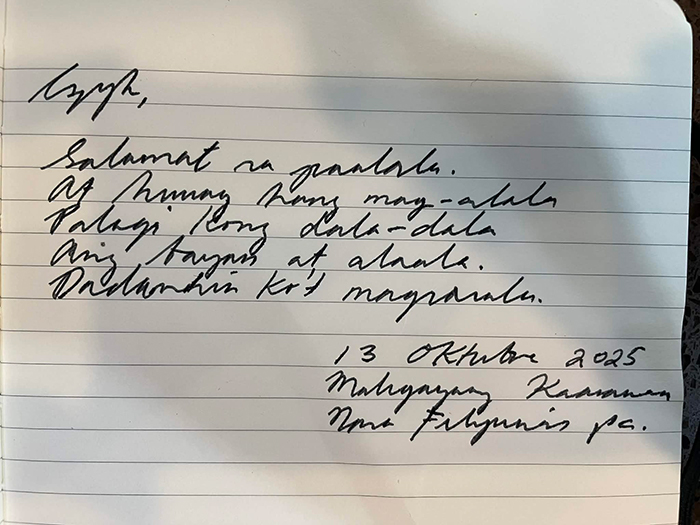
I release this now out of restlessness: a need to ask what art can still do when belief in it begins to waver. Motherhood has taught me that care is not always soft; sometimes it’s a form of vigilance, a refusal to look away. Making public this correspondence between friends is mainly for my daughter, Sophie, and for the young Filipinas just learning to speak, to make meaning, and to live with the world’s contradictions—not despite it.
“Be patient toward all that is unsolved in your heart,” wrote the German poet Rainer Maria Rilke, “and try to love the questions themselves.”
Literature, at its best, makes room for chaos and confusion. It reminds us that the world is never tidy, that even language fails us—and still, we write.
An open letter to RR Cagalingan
Huuuy R,
When you told me you’re flying to Germany on my birthday to perform at Frankfurt Book Fair, I felt proud and afraid all at once.
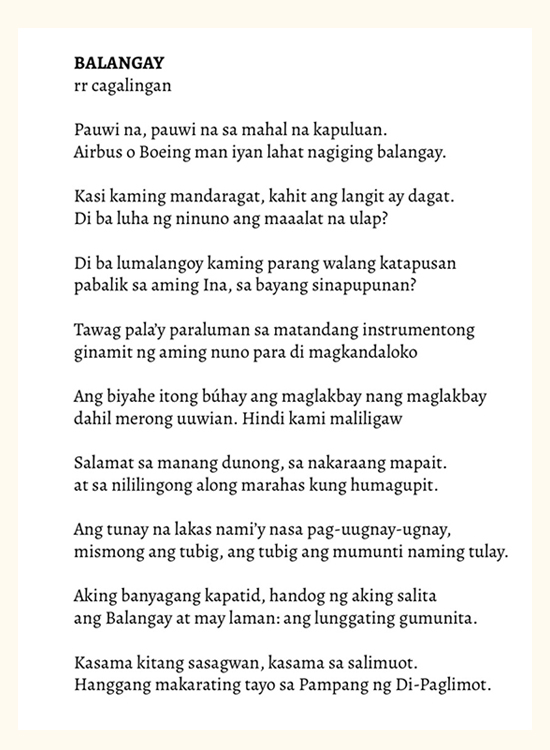
Proud, because few poets I know carry the fire of the Filipino the way you do—fierce, unyielding, pulsing with our mother tongue. You are one of the few who can stand onstage and still echo the street. My favorite optimist. I don’t know where you get hope. Alam mo, isa ka sa mga paborito kong makata.
Afraid, because I know the stage you’ll stand on is built from contradictions too heavy for any voice to bear.
“The Philippines is the Guest of Honor this year.” That phrase sounds grand, doesn’t it? After years of waiting, finally, we have an invitation to “the table.”
But oftentimes, being invited means being measured—curated and arranged under someone else’s light. The global market loves a story it can display: diversity as spectacle, resistance, and oppression as brand. Unfortunately, sometimes, the world doesn’t listen to our stories; it buys them.
I think of us, making art from scraps and rejections, performing with no crowd, metaphors jammed in desktop printers, xeroxed poems finding their way through invisible gatherings, going home from small fairs nang walang pamasahe pauwi, blogs na tayu-tayo lang naman ang nakakabasa, homemade websites left to rot. I think of us, publishing out of love and debt.
And so when your name appears in lights, it feels like all our unread chapbooks, zines, and unpaid nights are somehow valued—like the world accidentally glimpsed the labor it forgot to thank.
To see your name projected onto the world’s largest book fair is like standing before a mirror that doesn’t know our language.
You’ve performed in parking lots, on the streets, written poems for the oppressed, protested, as if words themselves could pull someone back from silence. You’ve kept faith in the gentlest weapon you know: a poem.
I don’t doubt your conscience. I never will. I only wish the stage you’ll step on will feel the same disquiet we do here—those of us who chose to stay away, not out of judgment, but because the air there feels too thick with silence.
When the fair silenced Palestinian author Adania Shibli and stood with Israel, something sacred cracked: the belief that literature could still be a place for truth.
And yet here you are, invited to perform.
Maybe that’s the hardest part of all: to be seen inside a house that erases others.
Hindi ko hinihiling na ‘wag kang tumuloy. Hindi ko ito sinulat para hindi ka pumunta, o mag-cancel ka ng performance. You are my friend, and I will respect and protect your freedom to my last breath—as you would mine. Ang hiling ko lang: dalhin mo sa luggage mo ang bigat na ito.
Sa iyong balikat. Sa iyong balat. Sa iyong bibig. Sa iyong dibdib. Sa bawat yapak.
Let your performance hold the violence and tension—the ache of wanting to speak, and the grief of those whose words were buried. Let your lips tremble with the dissonance.
When you stand before that crowd, remember that your body is already a protest. That your tongue, shaped by colonization, unpaid labor, and struggle, does not need translation to wound or to heal.
Don’t forget: even light can blind. So let your poem open their eyes.
Because we are all still here, writing from the cracks. Publishing, poetry, your translations—these are our ways of caring for the world, even when it doesn’t care for us. They are our quiet resistance against erasure.
Alam ko, para sa marami sa atin, hindi madali ang tumanggi. Boycotting Frankfurt was never a purity test; it’s an act of survival. But I know that for some of you who are going, it’s also for you to catch your breath.
Para sa’yo siguro, stepping into that space might be your own way of fighting back. Maybe that’s what solidarity looks like now: not one clean gesture, but a constellation of difficult choices bound by grief and care.
It was too much for me to talk about this yesterday. I have very close Filipino-Palestinian friends, and with so much anger around us from all sides, I just wanted to catch up with you on a personal level—to remember that our lives and friendship still matter too.
So, R, when you speak there, let your poem remember the silenced. Let your mic carry the names of those we lost. Let your art remind them that to see a Filipino is to see a people still learning how to survive an empire, still making books out of hunger and hope.
This is the weight of being seen.
It’s not about their applause; it’s about what you do with the light when it finally touches you. And when it does, let it burn where it must.
Ang dami ko pa sanang gustong sabihin. Pero dito na lang muna.
I can’t wait to watch you set that stage on fire. Don’t forget to record it for us. My daughter, Sophie, can’t wait to see it too.
Sa alab at pagkakaibigan,
Z
***
Si Z ay isang Filipinang manunulat at kasapi ng hukbong Pingkian. Itinatag niya ang Kwago bookstore at lathala lab noong 2017, isang espasyo para sa malikhaing paglilimbag at mga eksperimento sa panitikan tungo sa mapagpalayang lipunan.