

Poems on loss and discovery
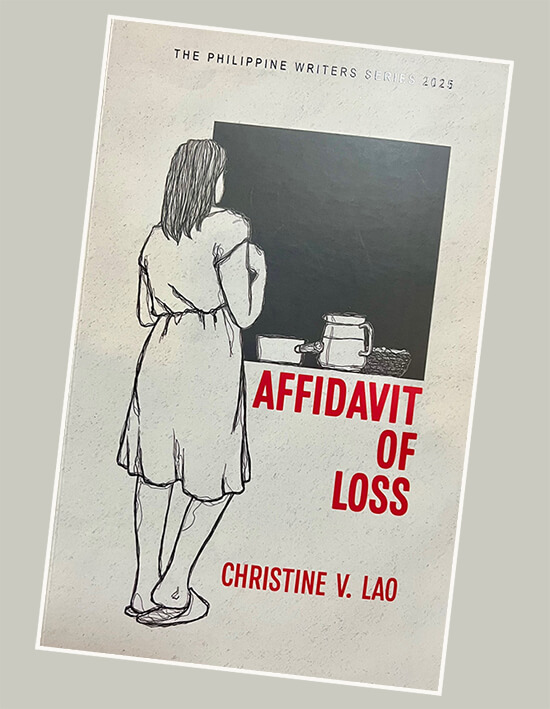
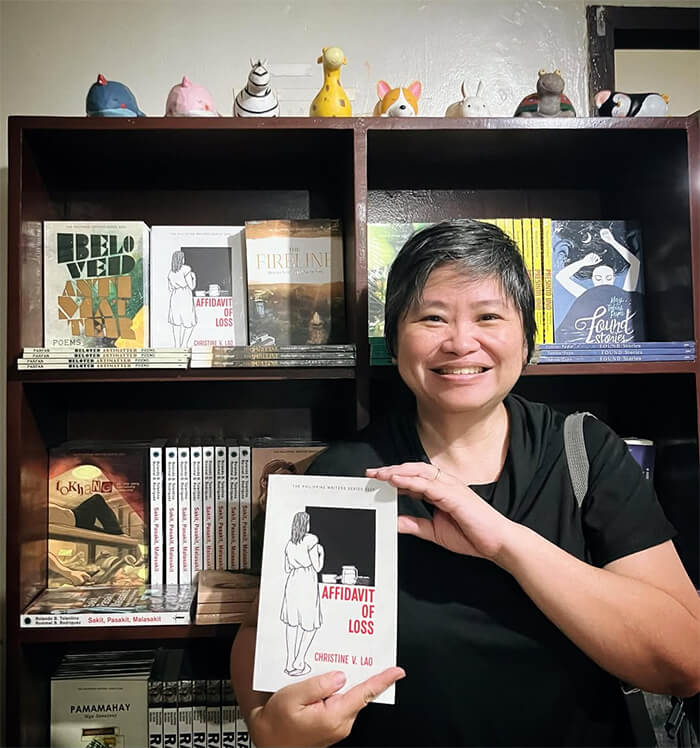
Christine V. Lao teaches writing at UP Diliman. She has practiced law and served as judicial staff head of the Supreme Court. Her first book, Musical Chairs: Stories, was a finalist for the 19th Madrigal-Gonzalez Best First Book Award, while Affidavit of Loss received the Gawad Antonio Mercado Abad for Best Dissertation from the College of Arts & Letters, UP Diliman.
A few months back, it was published as a poetry collection as part of the Philippines Writers Series 2025 of the University of the Philippines Press.
For a back-cover blurb, fellow poet Isabela Banzon writes: “In Lao’s poetry is a clear voice that attests to a loss, but not of material possessions, at the same time, and more imperative, a voice that seeks not replacement but a recovery of the true meaning of law and its reasons for being.”
In the poem “The Law looks into the mirror,” the title segues to the first lines: “and sees the face of a child dragged out/ of bed too early for a passport appointment.// It is not her face but that of a child/ refugee. The Law has read/ about child refugees.// It is 1979,/ and they are always in the news,/ abandoned in wooden boats.// They have no passports, no mothers./ They are always crying./ The face in the mirror may or may not// be crying….”
On an earlier page, “Mysterious Loss” ends its final stanza this way:
“… I am three and already fallen,/ let in on the world’s secret at its badly drawn/ seams. When the lustrous fog rises to claim me,/ I don’t have the words: immutable/ solitude; mysterious loss; do I want this?/ no; there is no question.”
The mysteries of early loss are never quite reduced along that infinitesimal chasm between words that invoke reality as cold tenets of legality and those that seek the assuring warmth of poetry.
Lao’s forgiveness is all over the place instead, perhaps as grudging acknowledgement that the contours that characterize lines and phrases for this twinning of purpose can be allowed to claim their own defining identities—and yet mirror the understanding that subsumes both vocations.
I like best “Alias Josephine,” which is of a different register, delightfully enterprising in its forays farther away from the edges of reality. Here’s the full poem:
“They are burning your books, Pepe./ It is a mistake. A great wind is coming/ to feed the fire, the forests all ready,/ aflame with your words.// Your words, the chatter of morning birds/ but deeper. In sleep, you named all/ the exact animals of the world and they/ came alive.// How long before the city burns, the country/ reduced to ash? It is not as you intended./ It is as you intended. There is no comfort/ in these thoughts, not in the starless horizon// beyond this burning. No comfort/ in the shadow that mimics/ your overcoat, the crevice/ where the fatal bullets lodged.// This darkness is a straitjacket, a bullet’s/ trajectory, widow’s weeds,/ the costume one chooses to wear/ when falling off the map.”
The poem is remarkably complete with its allusions, negation, detailing of topography, and the vivid placement of a hero amid the contradictions disguised as patriotism.
It starts a series of poems individually titled “Alias Gretel …, Joseph …, Edith …, and Sylvia …”—each offering mysteries of discovery, as against loss. We can only settle for educated guesses to fill in the blanks enveloped by the verses’ references. Notes at the back of the book supply rewarding info, as they do with regards legal terms in Latin.
Another motif Lao explores with familiarity is about “The loyalty of things,” as with this potent excerpt from reality:
“The object refusing/ to be anything other/ than itself is loyal,// as the reflection/ in the mirror is loyal/ to Leila de Lima—// who peers into it/ each morning/ and finds in its depths// a self looking back/ with nothing to regret—/ and when she turns to leave,// the loyal mirror,/ without motive/ nor reason to hold her,// lets her go.”
Such nuanced poems of the here and now curve into spaces that border both rationality and wish fulfillment. Variety of typographic presentation enhances the venturesome spirit that flaunts these poems from an array of fountains of grace increasingly growing evident on each page. Graphic poems of serpentine arrangements, prose poems, declarations, a series of haiku as “Today’s headline,” the inclusion of Chinese characters and Filipino terms, a listing of suggested “Acts of subversion”—these are among the studied premises by which Christine V. Lao gratifies us with grace notes, whimsy, admonition, strength.
Then there is the sheer power, as with the last stanza of another poem titled “Today’s headline,” that outdoes that of any gavel:
“And it’s just like you to insist you know him/ like you know the weight of your fist/ that now pounds the table to insist/ the error lay in his refusal to surrender—/ though his hands were up, he was a soldier/ and should have known better than to piss off the Law/ who waited, trained a weapon on his back/ and waited all the time shouting as it waited/ for the slightest suggestion he was drawing/ a gun, the language it insists on.”