

Genoa & Lucca: Stunning Italian cities off the beaten path
I recently met a jet-setting Filipina who has been on 30 cruises in her still young life. Cruises and bridge, she says, are her elixir.
I don’t play bridge, but I understand why cruises uplift her and take her all the way up from the waves to Cloud Nine.
My husband Ed and I were recently on a Mediterranean cruise aboard the Silver Ray, a seamless blend of luxury and comfort. I was invited by Silversea through CITTI Elite, the top producer of Silversea cruises in the Philippines, to join the cruise. My husband was attracted to its value-for-money cruise price, it being a luxury cruise ship where each spacious suite has a butler aside from a room attendant, and joined me on an unforgettable journey.
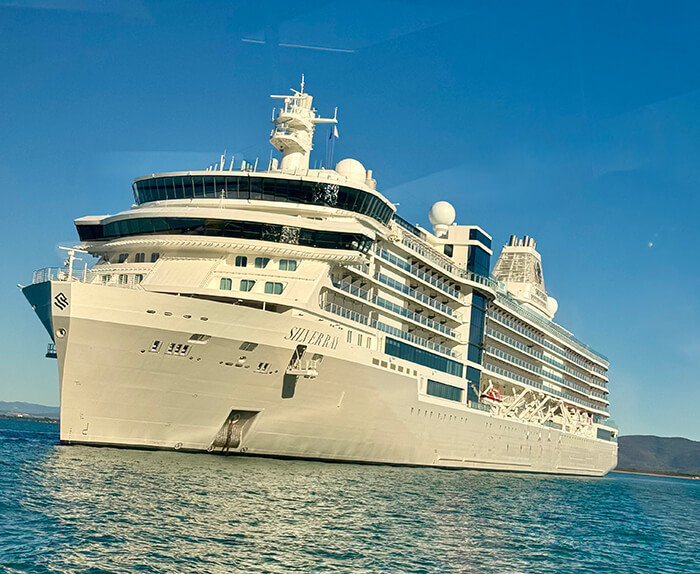
Though Takanobu Kobayakawa, Silversea director of sales for Japan, Korea, and South and Southeast Asia, encourages passengers to go beyond the ship and explore the shores, the Silver Ray is a destination in itself. Skippered by Capt. Giovanni Schiaffino, an Italian who endears himself to Filipino passengers by exclaiming “Hindi ako makapaniwala!” when he bumps into them, the Silver Ray is truly a “beam of light.”
The Silver Ray, unlike ocean cruise ships, has less than 700 passengers and almost a one-is-to-one passenger-to-crew ratio. The crew is about 80 percent Filipino, with the ship’s medical team head by a Filipino, Dr. Loyd Tuvilla, and its food and beverage outlets, overseen by a Filipina, executive chef Marixie dela Cruz.
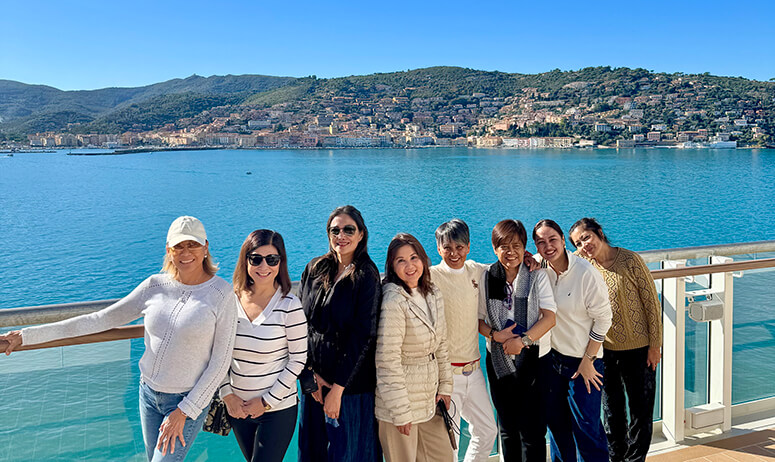
There are outstanding dining options in eight restaurants; and the elegant public spaces designed for relaxation and socializing. There’s also the music, an unprecedented choice of bars and well-curated shows in its Venetian Theater (where there were daily Catholic Masses at the time we sailed). There are many enriching onboard experiences such as the S.A.L.T. Culinary Program, where passengers can sign up for live cooking classes, usually of the cuisines of the ports you’ll visit.
Silver Ray’s Mediterranean itinerary brought us to less crowded but no less picturesque ports, from where we had the option to take several bus tours to charming and quaint cities off the beaten path.
One of them was to Genoa, said to be one of Italy’s “unsung destinations.”

Most famous for being the birthplace of Christopher Columbus, Genoa is the capital of Liguria, or the Italian Riviera. It was once the main trading center for Italy. Thus, Genoa has ornate gates, large, leafy palazzos, lavishly decorated churches, and a Centro Storico or Old Town that bears witness to its affluent past. The Old Town is one of Europe’s largest historic centers, a UNESCO World Heritage site known for its labyrinth of narrow, winding medieval streets called caruggi.
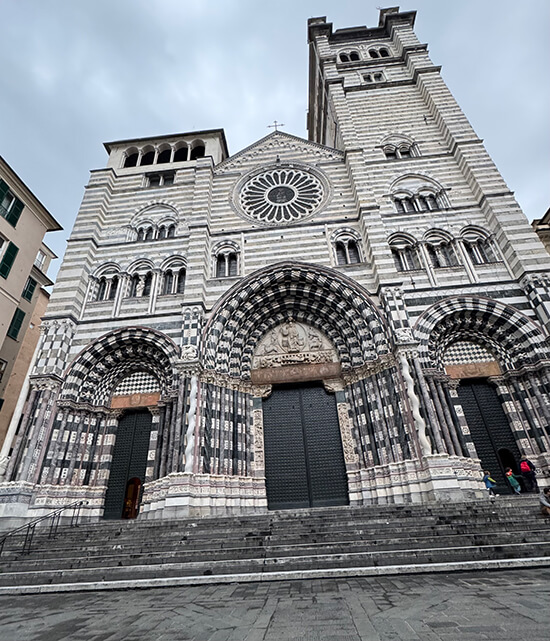
Visitors can explore its rich history through landmarks like the Cathedral of San Lorenzo, whose Gothic façade, completed in the early 14th century, is characterized by distinctive black and white horizontal bands and ornate marble detailing.
Near the historic center is a beautiful rotunda named Piazza de Ferrari with a majestic fountain surrounded by elegant buildings. Home of both pesto (with basil as the main ingredient) and focaccia, Genoa is considered by many to be one of the cornerstones of Italian gastronomy.
What really caught my eye in Genoa and planted itself in my memory was Boccadasse, a quaint, millennium-old fisherman’s village with multi-colored houses that reminded me of Burano in Venice. The houses are clustered around a tiny cove dotted with small boats. The coast looked like a watercolor painting.
From Genoa, we sailed to Livorno in Tuscany. From the port, you could head to Pisa, Siena, Florence, or to the shopping outlet near Florence. Since I had been to all four must-see destinations, I joined the tour to the medieval town of Lucca, which is generally off the tourist map, yet a sight to behold. Lucca is known as an Italian Città d’arte (City of Art) because of its Renaissance-era city walls and its very well-preserved historic center.
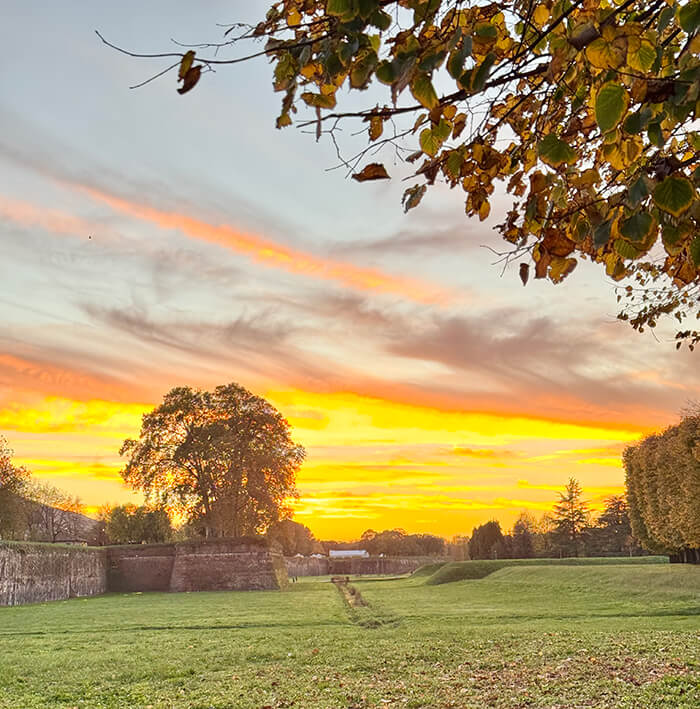
If only these walls could speak… Because Lucca’s walls, which surround the entire historic center, remain largely intact. The walls are so wide and sturdy that their top has been turned into pedestrian and cycling lanes!
Lucca is also known as the “City of 100 Churches” because there is a church on every corner, almost as numerous as 7-11 convenience stores. In fact, the San Frediano Church, striking for its large golden mosaic façade, is right beside one.
Lucca’s piazza (in Spain they would call it “plaza mayor,” in the Philippines, simply “plaza”) follows the shape of the ancient Roman amphitheater that once stood there. Mid-rise buildings, mostly in ochre, trace the piazza, known as Piazza dell’Anfiteatro.
And to classical music lovers, Lucca is the birthplace of Giacomo Puccini of Madame Butterfly, La Boheme, and Turandot fame.
At sunset, the sky forms a golden canvas against the ancient walls and is truly stunning. Listen to Puccini as you behold the sunset in Lucca, and like the walls, you will be witness to something truly divine.
Sail away and turn into a storyteller after your journey!
For more information, CITTI Elite may be reached at info@cittielite.net and (+63) 917 800 6010 / (+63) 917 167 4404.