The cold never bothered them anyway
At first glance, it feels like a continuity error. Onion domes rise against the darkness of the northern sky. Snow settles quietly on red brick. Then come the gowns—voluminous skirts, shimmering tiaras, bare shoulders bravely defying physics. This is Harbin in winter, where young women are staging elaborate princess photo shoots around St. Sophia Cathedral, and for a moment, northeastern China looks suspiciously like a snow-dusted corner of old Russia.
The cathedral, built in the early 20th century during Harbin’s Russian-influenced period, is the city’s most theatrical landmark. Its Neo-Byzantine design and unmistakable onion domes are remnants of a time when railway builders, merchants, and émigrés left their imprint on the city’s streetscape. Today, it’s no longer a church but a cultural space—and an irresistible backdrop for drama, nostalgia, and Instagram.
Watching this unfold as a traveler from a tropical country adds another layer of disbelief. I could barely take my frozen hand out of my pocket long enough to snap a photo before the cold burned back, and yet there they were—poised, serene, and seemingly unbothered by the subzero air. At temperatures hovering around -25°C, their focus never wavered. No shivering, no rushing—only the quiet determination to get the perfect image.
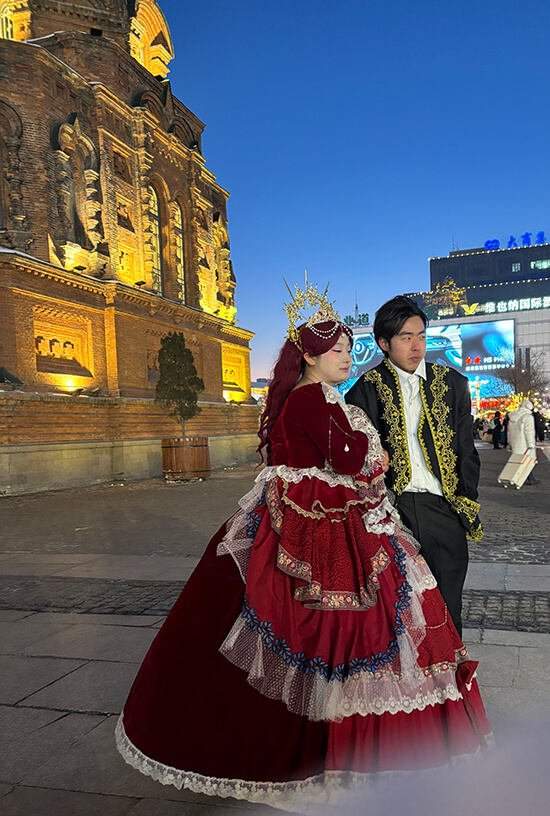
This winter spectacle stirred a familiar memory. I’ve stood in Moscow in similarly biting cold, where colorful onion domes rise against gray skies, and here in Harbin, St. Sophia quietly echoed that feeling. The silhouette, the scale, the way snow gathers on curves and spires—it all called to mind St. Basil’s Cathedral, thousands of kilometers away. It’s a reminder of how architecture can transport you, even before the costumes enter the frame.
Enter the princesses.
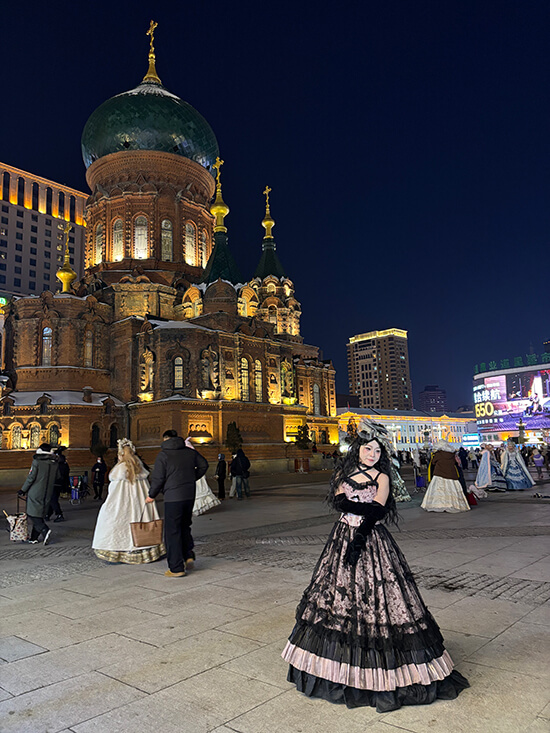
This winter trend—part performance, part souvenir—has become a fixture around Sophia Square. Local studios rent out ornate gowns, style hair and makeup, and dispatch photographers who know exactly how to work with frost, light, and history. The result isn’t just a portrait but a temporary transformation: young women (and a few men), briefly royal, framed by snow and a city that knows how to dress for drama.
What elevates the scene is the weather itself. Harbin does not do winter gently. The cold is assertive, uncompromising, and ever-present. Watching someone hold a graceful pose in layers of tulle while your own eyelashes threaten to freeze lends the moment a kind of reverence. This isn’t just about aesthetics—it’s about resolve.
For young travelers, the appeal is easy to understand. This is travel as immersion, not observation. Much like renting a hanbok to wander palace grounds in Seoul, dressing up in Harbin allows visitors to step into a narrative shaped by place, history, and fantasy. Clothing becomes a bridge between the traveler and the setting, between documentation and participation.
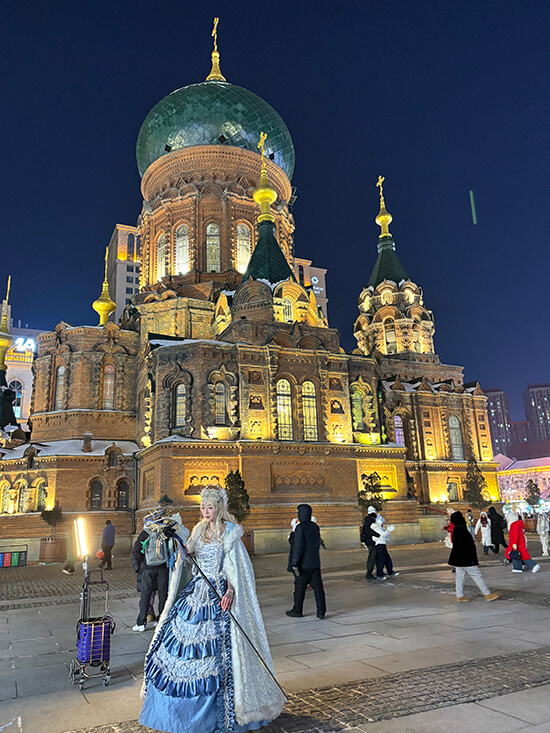
The difference lies in context. In Korea, traditional dress connects to living cultural practice. In Harbin, the gowns draw from the city’s layered past—a Chinese city shaped by Russian presence, now reframed through contemporary tourism and social media. It’s less about historical accuracy and more about atmosphere, and Harbin has atmosphere in abundance.
In the end, the princess photo shoots say as much about modern travel as they do about Harbin. Young tourists are chasing moments that feel cinematic, personal, and worth remembering long after the cold has thawed from their bones. Here, amid onion domes and unforgiving temperatures, those moments are captured in sequins and steam from the breath.
Just don’t underestimate the cold. From someone who comes from year-round heat: the crown may sparkle, but winter here shows no mercy.