

Painting the itch that needs to be scratched
Raul G. Rodriguez, artist and curator of the exhibit “Scratch To An Itch,” walks me through the Galleria Duemila space and mentions how hard it is to choose background music for a group show: you’ve got to pick a sweet spot between The Clash and Fleetwood Mac. Maybe Wilco, I suggest, because one artist’s canvas (Eric Sausa’s “The Order of Disappearance”) reminds me of them. He pauses and shrugs: “Maybe some Steely Dan.”
Curating a disparate group show is probably more complicated than settling on background music, even if you’re trying to integrate punk and ‘70s easy rock. The 12 artists involved—Al Cruz, Alvin Villaruel, Argie Bandoy, Dan Raralio, Don Djerassi Dalmacio, Erik Sausa, Joe Bautista, Jonathan Olazo, Jose Naval, Raul G. Rodriguez, Ronald Achacoso, and RM De Leon—were simply told by Rodriguez: “Just do what you like to do, or things you want to do but haven’t done before; just dive into that.” The show’s title comes from de Leon, whose mentor Roberto Chabet would say something like, “What is art? Anything that you want to scratch, like an itch, so that it will feel relieved.”
So let the scratching begin.
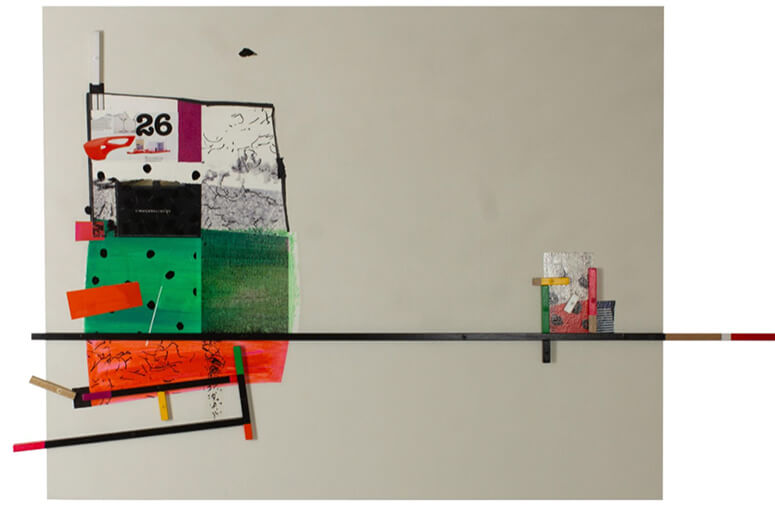
The most seasoned artist in the show, Bautista, or “Sir JoeBau,” was part of the fabled conceptual art group Shop 6 in the 1960s, alongside Chabet, Fernando Modesto, Yolanda Laodico, and Danilo Dalena. His “Two in One Structural Form No.4” and “Check Shop 4” here wittily reinspect the collages of Robert Rauschenberg and jutting spaces of formal Cubism, questioning the idea of painting itself, its polarity in a marketplace, and its ability to mutate.
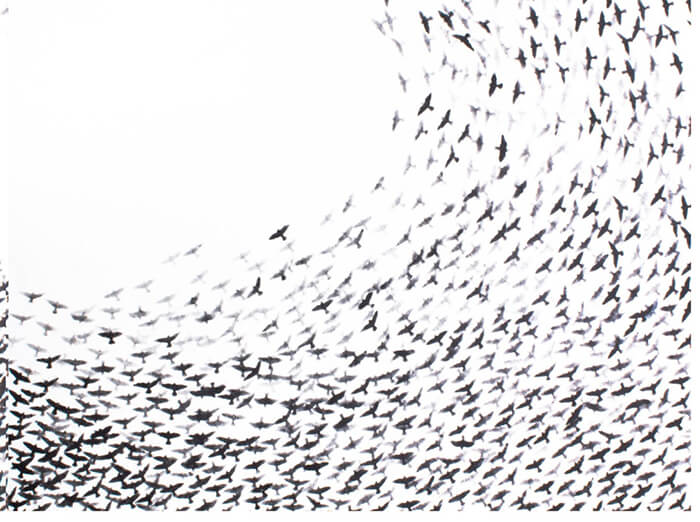
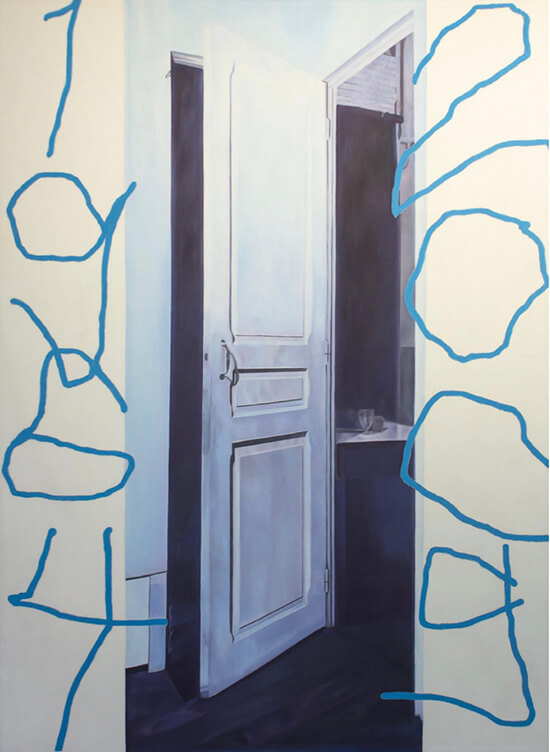
There’s Sausa’s “covert haikus” in black and white, dazzling arrays of stamps and pen markings; Al Cruz’s quizzical door frames marked “1964 2009”; Argie Bandoy’s “Triage” cleverly rescues lowbrow comic imagery, elevating it to new vistas yet unnamed; Don Dalmacio is similarly given to DJ mashup effects in his canvases.
Rodriguez himself offers that his own “National Recliner Watches the Bigger Fuzz” is a reflection on a U2 concert, the convergence of attention on a handkerchief-draped microphone stand.
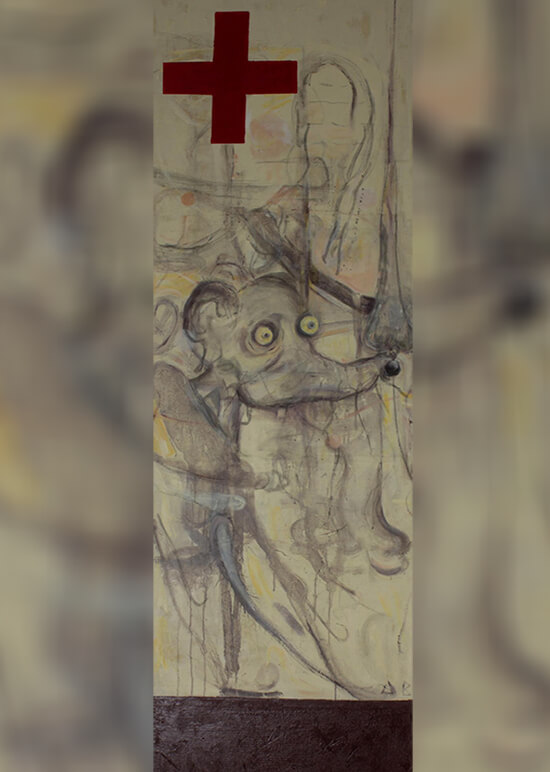
Ronald Achacoso begins his investigations with close-up National Geographic images, then imbues them with skin-like layering and cartographic symbology. Dan Raralio’s “Cryptic Vessels” also explores invented symbology, a code to crack in a recessed wooden space that feels both organic and industrial.
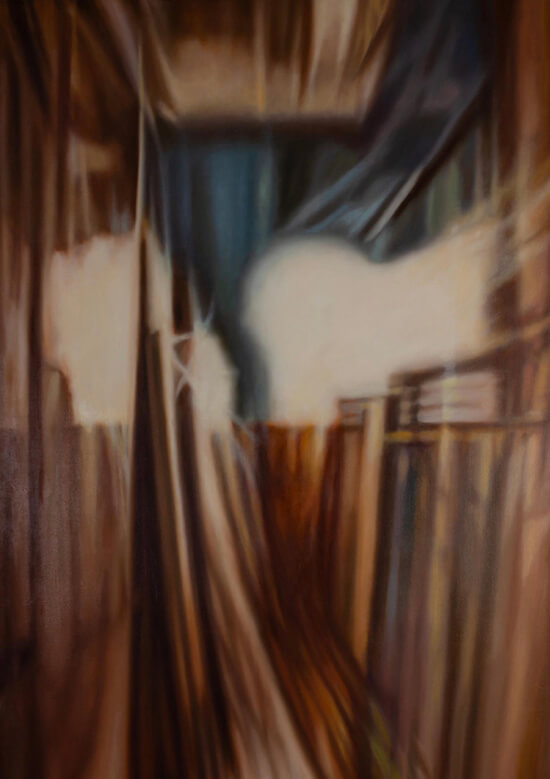
Leaning against the entrance wall, Alvin Villaruel’s large canvases enhance images grid by grid, retaining the fuzziness of imperfect photography in, say, window silhouettes cast on a white wall; but the results are less Gerard Richter and more a transformation of the created space into some poignant, vivid emotion.
As Jonathan Olazo puts it in his exhibit notes, “the observed eclecticism has one center: painting is the proverbial muse and the undeniable phantom pain, albeit persisting as a plain and two-dimensional, flat object.”
Appropriation is today’s currency. More than just an itch to scratch, it’s a way to channel and layer everything from the past through the canvas —artist as DJ mixmaster.
Something that Nicolas Bourriaud posited in a 2009 Tate Britain show: “Altermodernism.” Call it a “reloading process,” where creolized (hybrid) cultures seek to both reconnect with the global culture and preserve their own autonomy, scratching their way towards “the possibility of producing singularities in a more and more standardized world.”
That’s one way of looking at the hypermodern art world today.
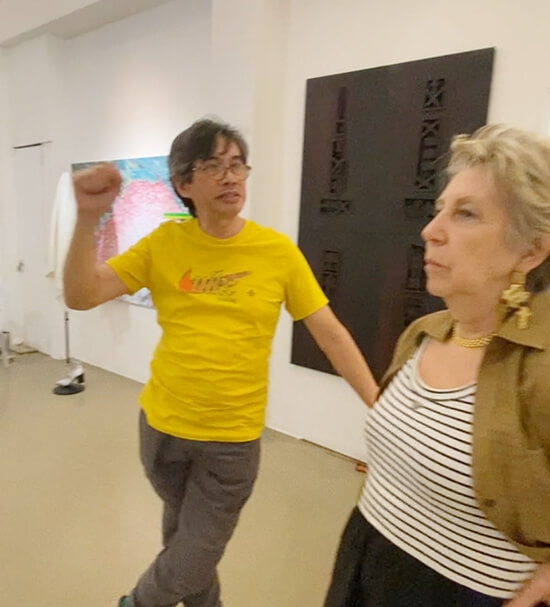
Galleria Duemila art director Silvana Ancellotti-Diaz simply sees it as a spigot that allows the new forms to be seen. She allowed me a sneak peek before opening night, where curator Rodriguez was still shifting works around. The gallery opened in 1975, now spanning a half century of shows, like last month’s impressive “Shadows Between the Lines” by Jonidel Mendoza. For the current exhibit, she notes the invites have a playful “scratch and sniff” component.
“I think the most important asset is to be able to go forward and make the people see, hey, there is this art wakeup,” she says. “I continuously push because I love what I exhibit. So my major focus is to believe in what I like. And that’s the show. And they go on.”
* * *
“Scratch To An Itch” is at Galleria Duemila, 210 Loring Street, Pasay City, until Oct. 11. Telephone 8831-9990.