

Everything in transit
There is a transitory idea of place and materiality that encompasses the works of Alfredo and Isabel Aquilizan. From meticulously constructed cardboard villagescapes to wings fashioned from sickle blades and upturned boat-pillars, their projects have often dealt with the idea of home and our instinctual attempts to “belong” or “fix” this place somehow, only to realize that “home” is as mutable as its materiality.
Drawing from experiences of migration, the Aquilizans have traced this evolving idea of home through assemblages of everyday objects that they have collected over time, sometimes through local communities they have engaged with (i.e., balikbayan boxes, blankets, slippers, farming implements). This habit of collecting is crucial to their art practice: collecting, after all, is often driven by a sentimentality for things—or more aptly to the storied materiality of things. In accumulation, these objects become microcosms of an ever-expanding world of things and meaning. For all their humble and mundane materiality, they eventually become fragments of a larger memory, a part of history.
So what happens, then, when there is no history to speak of? What happens when the object is wrested from the context that worlds it? Does it become an empty sign, its meaning lost to space and time, or is it finally set free?
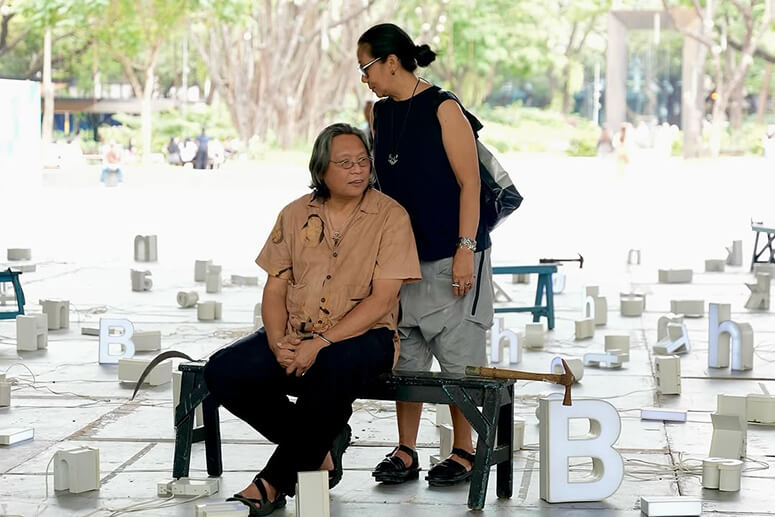
Alfredo and Isabel Aquilizan’s “Signs and Intimations,” on view at the Ayala Tower One Fountain Area for Art Fair Philippines’ 10 Days of Art, is an installation work that draws upon the possibilities of the seemingly empty sign. Employing old restaurant signage letters that scatter the floor space, “Signs and Intimations” invites viewers to engage with the work to create new possibilities for meaning.
“We came across these old decommissioned signage from Max’s Fried Chicken Restaurant that read ‘The House that Fried Chicken Built.’ And we thought of using it for an interactive work wherein we can draw people to engage through inventing words and phrases using the existing letters, and for them to express ideas, feelings, and thoughts, or just simply a play of words.”
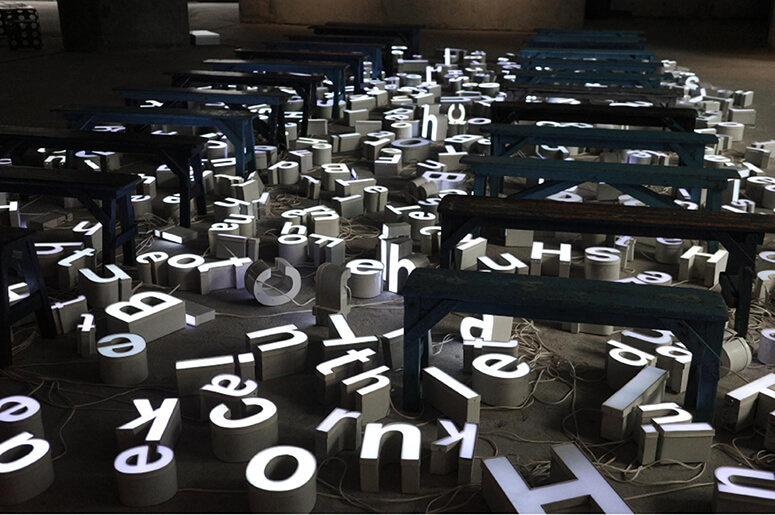
“We have always been fascinated with signage and advertising devices and how they affect us psychologically. And at the same time, how it makes us process, respond, and how it dictates our thinking and instigates immediate actions. We are very interested in words and letters and the narratives we can draw and create from them. For the past years, we have been collecting these devices and have been using them in our works and installations.”
While the installation employs readymade objects from the ubiquitous spectacle of graphic advertising, the signage, now deconstructed into single letters, revel in the collapse of meaning. Now far removed from the barrage of commercial advertising, what becomes of the space is a room for quiet pause, and more so for creativity—perhaps the very same sense of play that the artists themselves employ in working with their materials: the kind that defamiliarizes the familiar.
“Experience of dislocation unconsciously pushes you to see familiar things from a different point of view. With minimal interventions that decontextualize the objects on view and through the juxtaposition with space, time, and the participation of the audience play an important role in the creation of meaning,” the artists state.
As the viewers engage with the work, the ephemerality of meaning is realized. The scattered letters, as they are rearranged, become a palimpsest of playful meaning constructed momentarily by each passing visitor. What were formerly empty signs thus become inflected with memory, a storied materiality, yet seeming to last only until these letters are rearranged once again.
Perhaps in this way, “Signs and Intimations” also speaks to the artists’ experience of geographical dislocation—as migrants who come and go, and thus must constantly accustom themselves to the mutability of meaning and materiality. Caught up in the search for home in the spaces they dwell in and have dwelled in, their assemblages become material contemplations of everything in transit, as well as their still countless destinations for possibilities of meaning.