Chasing storms: Why James Reynolds traveled to PH in pursuit of typhoons
When skies grow dark and the wind begins to whisper of a coming storm, most people would pack up their valuables and evacuate the area before things get dangerous, but for James Reynolds, it’s a signal to grab his camera and head straight toward the action.
A seasoned storm chaser who has documented some of the world’s most powerful storms, Reynolds recently flew to the Philippines in pursuit of Typhoon Tino, and subsequently, Super Typhoon Uwan. Before the latter even made landfall in the country, authorities issued warnings as images from PAGASA showed the storm could cover the entire Philippines.
But Reynolds wasn’t one to back down. Where most saw danger, he saw an opportunity to tell a story only a storm chaser could.
Coming to the Philippines
As a storm chaser, Reynold’s mission is to go into areas likely to be most impacted by a typhoon ahead of time and transmit to the world everything that he’s observing in real time most accurately.
“It’s primarily so people can get the clearest and most up-to-date truth of what is going on during these storms, because it's obviously a very anxious time for many, many people, not only those who are being impacted, but those who are far away and may have family and loved ones there,” he told PhilSTAR L!fe.
Reynolds shared that he decided to extend his visit to the Philippines when he learned about the potential danger of Uwan.
“Large typhoons in particular always get my attention because their effects are felt over such a wide portion of the country, so I knew this was going to be an important storm to cover, a dangerous storm to cover,” he said.
Reynolds and his partner, fellow storm chaser Mark Thomas, headed to a hotel in Baler, Aurora to set up their operations, believing it to be the safest location to document Uwan’s expected landfall.
Despite this, problems continued as the ground floor of their hotel was flooded due to the storm surges.
“The waves were breaching over the top of the seawall in Baler, but the seawall did a great job of protecting that waterfront area. But it was still hazardous. Some of those waves were coming over and crashing into the hotel, strong enough to sweep people off their feet if they were caught in them,” he said.
In preparation for Uwan, Baler residents battened down the hatches.
“The hotel we stayed in had wonderful management and staff. They were really doing everything they could to make sure everyone was safe. We were all pitching in, helping sweep the water out. Each time a big wave came in, everyone would be there ready to get the sand and the water out and then just repeat that process,” Reynolds recalled.
He highlighted how Filipinos were “keeping good spirits” amid the bleak situation, which inspired him.
“As always in the Philippines, it's prepare physically and mentally for these storms. I’m just very impressed with the resilience, the toughness of the local people I'm with when a typhoon is approaching,” he said.
What got him into storm chasing
Reynolds has fostered a fascination for typhoons and other natural disasters ever since he could remember.
“I'm a very curious person at heart, and my curiosity has led me down this path where I find myself 20 years after witnessing my first typhoon,” he shared.
Part of what ignited his interest was his hometown of Gloucestershire, southern England, which rarely experiences major weather or geological events.
“The weather there is pretty benign and calm most of the time, so being exposed for the first time to the tremendous forces of nature that we see in the Western Pacific and in the Philippines especially, really just ignited this burning curiosity inside me to witness more of these kinds of phenomena,” Reynolds said.
The first typhoon he ever witnessed was Haitang back when he was living in Taipei, Taiwan as a language student in July 2005.
“It's one of those kinds of pivotal moments in my life, as crazy as that sounds,” Reynolds remarked. “A very, very large typhoon happened to be coming towards the country when I was there, and I was just like, ‘Wow, I've never seen so much energy and such a quick change in the weather as what you get when a typhoon rain band sweeps over you.’”
From there, he just fell into the rabbit hole even further until he eventually became the passionate storm chaser he is today, delivering updates from underreported parts of the world.
Preparing for the chase
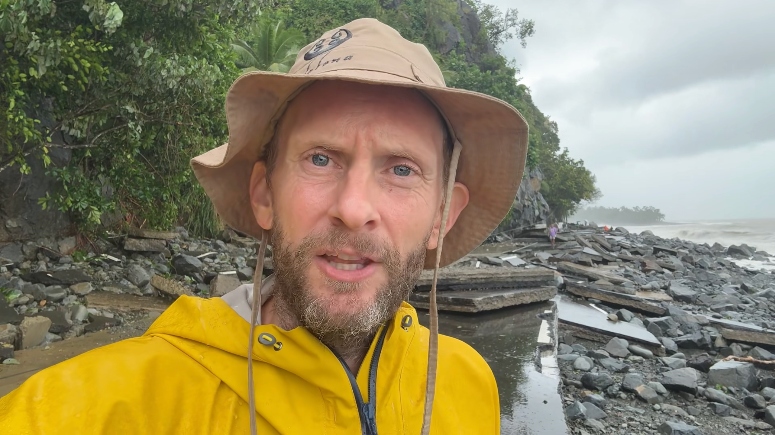
While his job requires him to be courageous, Reynolds is not immune to fear.
“There are a series of emotions I go through when I'm chasing a storm. The lead-up to the storm is always on a personal level, the most unpleasant part. It's where there's maximum stress, maximum anxiety, a lot of pressure on myself—not only to keep myself safe, keep my car safe, but also just to make sure that all my technology and systems are working so I can get my job done properly,” he admitted.
“And of course, missing my wife and kids back home, so all of that kind of melts together to just a lot of tension and anxiety,” he added.
But once the storm is in progress and he has set up properly, that’s where all his fear transforms into focus.
“That's actually kind of almost the easiest part. If I've done my job right, if I'm in a safe place and everything is kind of under control, and obviously everyone around me is okay, that's usually when all my natural instincts just kick in and I can get on with my job. And that feels satisfactory to me,” Reynolds said.
He acknowledged that while not every typhoon is a hideous, destructive killer, many of them unfortunately are. This is why he needs to ensure that he has checked all the boxes when it comes to safety and readiness.
“You need somewhere that is going to keep you high enough above sea level so that you're not going to be swept away by storm surge, preferably away from any river or water channels. So if there's a big flash flood, it's not going to wash the building away. And then primarily a nice, solid concrete structure will keep you nicely protected from the strong wind or debris and things like that,” he said.
Of the many storms he has chased, Reynolds said that Super Typhoon Yolanda, which devastated the Philippines in 2013, was one that has stayed with him since.
“When we had chosen a building—a magnificent, solid hotel with four floors, so lots of elevation—everything seemed to be under control for us. And then the moment when the storm surge started coming into the city and then the chaos and the death and destruction that it started to bring, it was a moment which I'll never forget,” he recounted.
“How everything went from ‘Okay, we're under control’ to ‘Oh, this city is being devastated in a matter of minutes’ was very much stuck in my mind,” he added.
Things got more dicey when his partner Thomas got badly injured after he went into the storm surge to rescue some people who were panicking and stuck in a room.
“He wasn't being reckless or stupid or anything like that. [He] was very fixated on trying to help other people and unfortunately got hurt in the process of doing that,” Reynolds said.
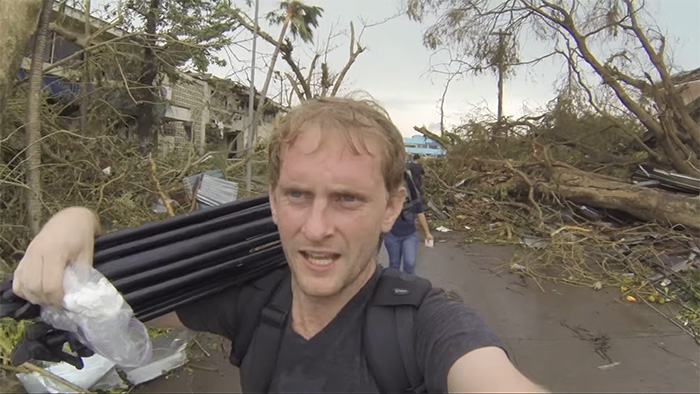
He continued, “It's just a very important reminder for us, as storm chasers, that things can and do go wrong and the stakes are very high. If you make a mistake or things do go wrong, you can end up in serious trouble.”
When traumatic events like these happen, Reynolds simply does his best to learn from his mistakes to prevent similar occurrences in the future.
It also helps that his family remains a constant source of support despite the danger that comes with his work.
“They know it has its risks, but they know I'm very passionate about it, and they're supportive of that. It's a core part of who I am. What I do is a part of my identity. I'm the guy who goes into the typhoons and documents them. I never planned it to be that way, but that's the way it is, and I think it's the way it always will be until I physically can't do it anymore,” Reynolds underscored.
Uwan has now left the Philippine Area of Responsibility on Nov. 11, but it may still re-enter on Wednesday evening as it makes landfall and weakens over the southwestern coast of Taiwan. It's forecast to further weaken and completely exit PAR on Friday, Nov. 14.