How large and heavy are millions of pesos?
It appears that money has been on every Filipino's mind lately, especially with pressing issues such as the alleged corruption involving flood-control projects continuing to flare up.
As statements and revelations on the topic fill everyone’s social media feeds, one image shared by dismissed Department of Public Works and Highways engineer Brice Hernandez during a House of Representatives inquiry ignited public fury. The photo showed tables with thick bundles of cash allegedly used to pay politicians as part of the kickback scheme in the flood-control projects.
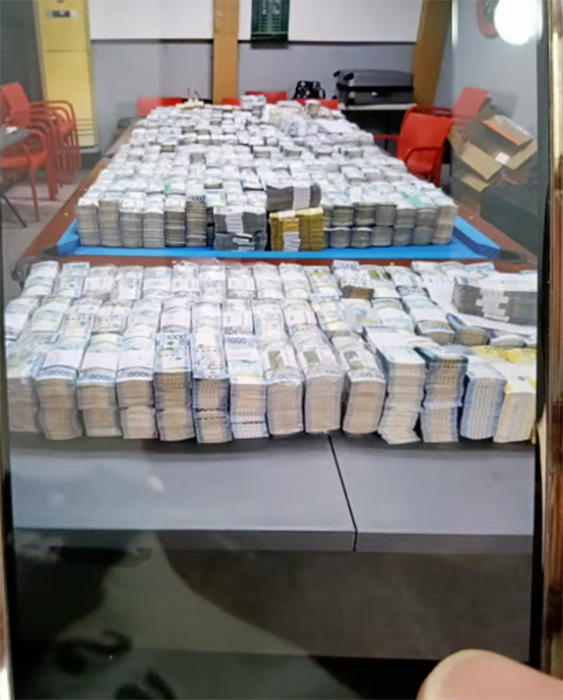
As people tried to wrap their heads around the magnitude of the money, one strange yet practical question emerged: How much physical space does that kind of money actually take up?
PhilSTAR L!fe spoke with bank managers to find out how large cash transactions are typically handled, and whether an everyday tote bag could handle it.
Can you fit millions of pesos in a bag?
A single P1,000 bill may be as thin as a strand of hair, but stack enough of them together and you'll find yourself dealing with a small brick of cash that quickly takes up space.
Doing the math, 100 pieces of P1,000 bills equate to P100,000. This makes 10 bundles equivalent to P1 million.
"This (P1 million) is enough to fit in a short, brown envelope, while long, brown envelopes could fit P2 million," said Paula (not her real name), an officer-in-charge for a private bank in the Philippines.
"Sa bank naman po during transfers, may duffle bags po talaga, pero kapag malaki masyado, sa [Bangko Sentral ng Pilipinas] boxes po nakalagay. One box could fit P50 million," she added.
Meanwhile, Joseph (not his real name), who works as a senior manager for a local bank, specified that a million pesos in P1,000 bills would stack up to about six to seven inches tall—or roughly the length of a handspan.
It can easily fit in a regular handbag or tote bag, but in a situation where a billion pesos would need to be carried, he said that you would already need a larger bag or a box to carry the money.
This goes the same if you’re dealing with smaller bills like P100, as you will need 100 bundles of P100 bills to make P1 million.
Pretty much any large handbag can be used to carry a million pesos in P1,000 bills. One brand that comes to mind is Longchamp's lightweight foldable bag, which is known for its flexible, spacious design, and it can easily accommodate a large volume of cash.
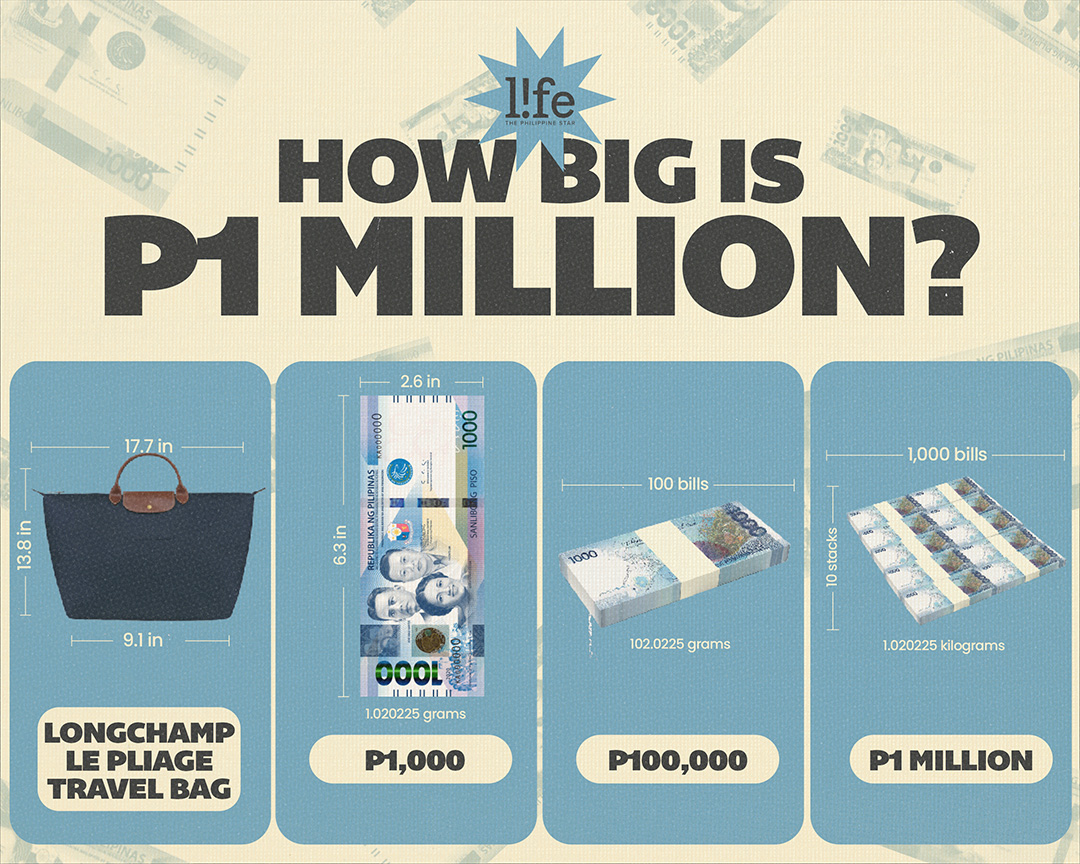
In an email inquiry, the BSP told L!fe that the average weight of a P1,000 paper banknote is 1.020225 grams, while the P1,000 polymer banknote comes in at 0.936625 grams.
1,000 pieces of P1,000 polymer bills, which equate to P1 million, would weigh 936.625 grams or nearly 1 kilogram. P100 million in P1,000 polymer bills would come in at 93.6 kilograms—as heavy as two average-sized adults.
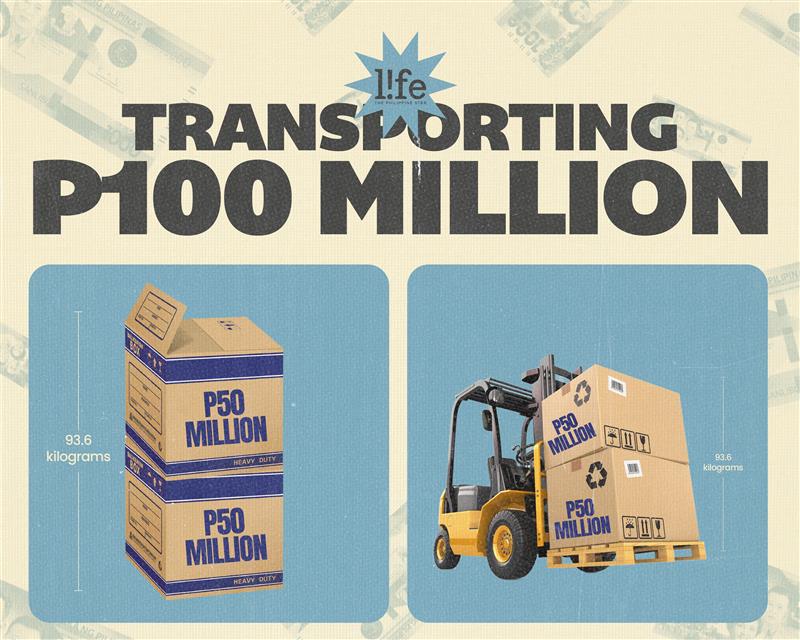
That's also nearly twice the weight a male worker is allowed to lift (50kg), according to the Occupational Safety and Health Standards set by the Department of Labor and Employment. The guidelines state that load over 50kg for men and 25kg for women shall either be "handled by more than one worker or by mechanical means."
Rules for transacting with large amounts of cash
While you may be able to fit a million pesos in a tote bag, getting it past a bank teller is another story, as there are rules you must follow when it comes to transactions involving large amounts of cash.
Paula said that cash withdrawals or deposits involving covered transactions will need documents as to the source or purpose of the money. This is a requirement from the Anti-Money Laundering Council of the Philippines.
Republic Act No. 9194 defines a covered transaction as a "transaction in cash or other equivalent monetary instrument involving a total amount in excess of P500,000 within one banking day."
The BSP has also limited cash withdrawals to P500,000 per banking day.
This is to prevent money laundering, which is the criminal practice of processing ill-gotten gains, or "dirty" money, through a series of transactions.
Transactions are considered suspicious when the client has not been properly identified, the amount involved is not commensurate with their business or financial capacity, or the transaction is related to an unlawful activity, among other reasons.
Joseph pointed to a past incident where $81 million (P4.6 billion) was wired to Rizal Commercial Banking Corporation's branch in Manila, which was later withdrawn, converted into pesos, and gambled in local casinos.
"There have been stricter policies from BSP after this incident happened. Many safeguards or changes were made so that higher management would know that huge amounts in cash are being deposited or withdrawn," he said.
When it comes to withdrawing money from the ATM, each bank has its own set of rules that you can look up on their websites, but the average limit per day is P50,000.
For cross-border transfer of local and foreign currencies, the BSP imposed that a person may freely bring into or out of the Philippines, or electronically transfer, up to P50,000 only.
If the amount exceeds that, you will need to have a prior written authorization from the BSP and a declaration of the whole amount brought into or out of the Philippines using the prescribed Currencies Declaration Form in case of a physical cross-border transfer.
However, the central bank stressed that they are only allowing such transfers for "testing, calibration, or configuration of money counting or sorting machines; collection of currency; and currency awareness."
How kickbacks are transported
During the Senate Blue Ribbon Committee hearing on Sept. 18, top government contractor Curlee Discaya admitted to paying kickbacks of 10% to 25% to DPWH officials in Quezon City to get projects.
He told Sen. Risa Hontiveros that he would withdraw large amounts of cash from the bank that would be picked up by DPWH officials' staff.
"Minsan nagkikita po kami sa Shangri-La or minsan po sila po ang pumupunta sa office," Discaya said.
"Kadalasan po, Your Honor, ano lang po, nasa paper bag lang po ['yung pera]," he added.
Meanwhile, on Sept. 9, Hernandez presented during the House inquiry photos of piles of money for flood control projects allegedly taken at the Bulacan 1st District Engineering Office from around 2022 or 2023.
"May mga designated person po na pagbibigyan 'yan," he said, adding that the cash would go to "proponents" that former DPWH Bulacan 1st District Engineer Henry Alcantara was talking to.
Sen. Ping Lacson, in the Senate session on the same day, endorsed filing charges for violation of the Anti-Plunder Law against the implicated officials.
"Sapat naman pong basehan ang nakakapangilabot na laki ng halaga ng mga anomalya sa flood control—bilyones po ang pinag-uusapan nating nauwi sa ghost projects," he said in his privilege speech.
Lacson also alleged that dismissed officials Alcantara, Hernandez, Japee Mendoza, Arjay Domasig, and Edrick San Diego—a.k.a. BGC Boys (Bulacan Group of Contractors)—lost over P950 million in casinos.
"Ang marangyang pamumuhay ng mga sangkot na opisyal ng DPWH, at ang daang milyong kaya nilang ipatalo sa casino, ay kabilang sa magpapatunay sa paglabag sa batas na ito. These facts show that the accumulated ill-gotten wealth has undeniably breached the minimum threshold for Plunder, which is at P50 million pesos."