Feeling tension with the Serrano sisters
After a night of a raging storm, I stare point-blank at a digital mood board, a series of images, text, and textures I can only describe as “watercore.” Created seven months ago and intended for private consumption, it’s only one of the several mood boards that filmmakers Gabriela and Mariana Serrano filter into specific decks for their latest short Surface Tension, premiering in-competition at the 2025 QCinema International Film Festival.
The film follows young swimmer Bulet (played by Mariana), who returns to her hometown in time for a cousin’s wedding. The result is every bit as defined and tactile as the lives the Serrano sisters used to live. On one hand, it is a muted grief drama; on the other, it is a slippery unspooling of deep private histories, encumbered by time and concerns of identity.
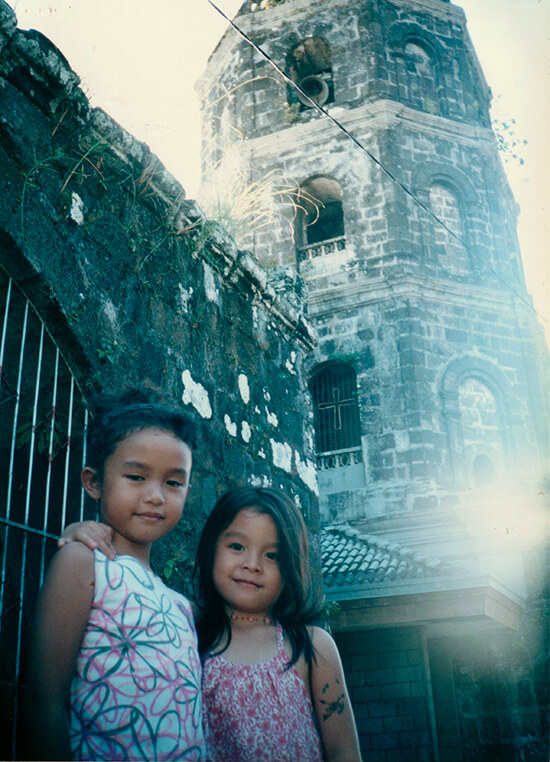
The photographs of children featured in the film are actually the filmmakers as kids. The locations where they shot are real places they grew up in, including their beloved lakeside home in Cavinti, Laguna. Its central metaphor takes its cue from a story of their grandmother “being trapped in a loop by a diwata” in the town river, essentially giving the film a sort of myth-dream logic.
“The entire film is our joint synthesis of actual images, textures, feelings, words we each experienced quite viscerally during our childhood and recent processing of our individual grief,” says Gabriela. That grief, explains the younger Mariana, stems from separate heartbreaks—one about ending a longtime romantic relationship, the other about bidding goodbye to a childhood home—that were beginning “to mirror each other.”
“We noticed that if we removed specific names and details, it almost sounded like we were talking about the exact same loss,” says Mariana. The mysticism eventually allowed them to come up with a story that is “singular in nature but a revelation of two,” one they figured out during a conversation in the water after doing laps in their village pool, the exact pool shown in the film.
This reimagination of a personal myth parallels the spirit of their Cinemalaya-winning debut short Dikit, which doubles as a glorious queering of the myth of the manananggal and a compelling paean to Jose Nepomuceno Jr.’s forgotten short film. This adherence to folklore and the incomprehensible, notes Mariana, speaks of their shamanic lineage, which finds them “revering the forest and its dwellers.”
“But there is also a deep desire to talk about our everyday lived experiences as girls and sisters in neocolonial Philippines,” Mariana explains. “Something we are unpacking and learning how to articulate each day, while also discovering (that they) are the same stories our elders—our mom, her sisters, our Titas, our Lolas—had as girls. It’s by choosing to follow the threads that have been woven through and around us that we realize the heart of our projects lies in the fact that we are all intertwined.”
It’s no surprise that the Serrano sisters insist on working chiefly with women and queer creatives in every artistic endeavor. If anything, it is this insistence that propels the cinematic visions they shape together. “The girls just get it,” Mariana neatly puts it.

In Surface Tension, the filmmaking duo involves the likes of Celeste Lapida as creative producer and assistant director, Patrick Pangan as assistant director, Kukay Bautista Zinampan as production designer, Claudia Michelle Fernando as art director, and Nicole Rosacay as sound designer.
“We know this (from) having both experienced machismo in professional settings,” explains Gabriela. “Women and queer creatives are predisposed to collaboration based on care, open dialogue, mutual support, (and) nuance. When you pull a team together over these foundations, you quell a lot of the unnecessary ego you would usually encounter on less diverse film sets.”
“We’ve developed this nature on set, of welcoming the unknown,” Mariana says. “Our first short, Dikit, taught us ‘movie magic’ through serendipity. Since then, we’ve been buoyed by the belief that things fall into place, without or even despite your control. We do as much prep as humanly possible before the shoot, but when we get on set, it’s playtime. That’s why it’s paramount to trust who you’re working with.”
Produced at the height of the pandemic, it was Dikit that formally kickstarted the sisters’ artistic collaboration. Gabriela served as director, co-writer, and editor in Dikit, while Mariana served as co-writer and lead actor—a setup they’d repeat in the 2025 short Elenita Elena Elaine, retitled from dreamtime™ and set to compete at this year’s Singapore International Film Festival. A story of three women in neon-drenched Manila, where dreams are outsourced via advanced technology, Elenita Elena Elaine is the short companion to the duo’s upcoming feature Please Bear With Me, which has been reaping recognition from different international labs and project markets.
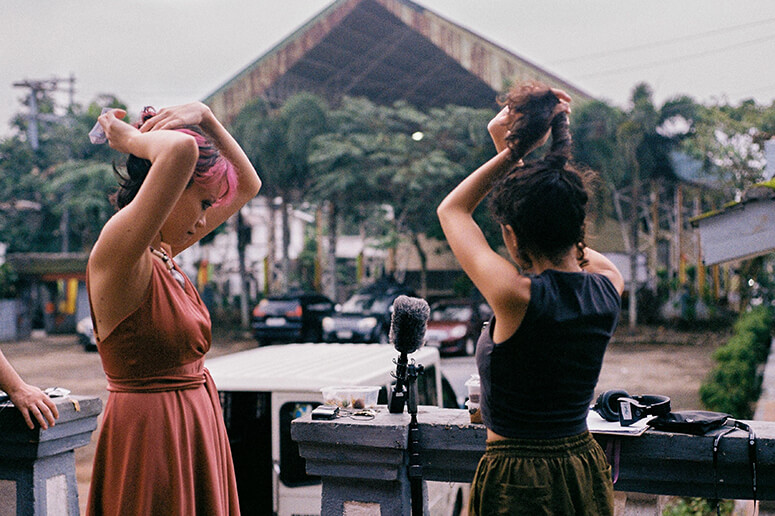
Raised in Las Piñas, the Serrano sisters were already into art growing up: Gabriela was more into making music and visual art, while Mariana was into the performing arts, dancing and playing leads in campus theater. Their individual processes and sensibilities, it seems, not just complement but inescapably bleed into each other. “We form a concept together, then in realizing it, I take care of the semiotic and visual technicalities, while Sam (Mariana’s nickname) focuses on dramatic elements, making sure the story lands emotionally,” Gabriela says.
“Funny, we made Dikit and swore we would never make a dual-screen movie ever again,” recalls Gabriela. “Here we are four years later, fusing our two separate life experiences together on film for Surface Tension.”
“Never say never,” Mariana adds. “Maybe for our next one, you’ll do some of the acting too.”

Surface Tension sees the Serrano sisters teaming up with Dikit cinematographer Aaron Marasigan, resulting in a visual lexicon that shifts between ratios and camera formats (camcorder, GoPro, and Alexa Mini) “to mirror feelings of dissociation we connect so much to the experience of heartbreak” and obscures timelines and temporalities “to explore the psychological dichotomy between the surface world and being underwater” in service of “hazy realism.” Some film references include Rachel Getting Married by Jonathan Demme, La Cienaga by Lucrecia Martel, Moving by Shinji Somai, and Turumba by Kidlat Tahimik, among others.
During their four-day shoot, Gabriela says the crew encountered some logistical and geographical hurdles, including a last-minute gamble to film the wedding scene in dilapidated houses surrounding a Laguna church meant to be the original location. But it was the emotional whiplash of shooting Surface Tension after a year of healing that Gabriela largely fretted over. Yet, as she puts it, “there was padding along the way into that dark spot.”
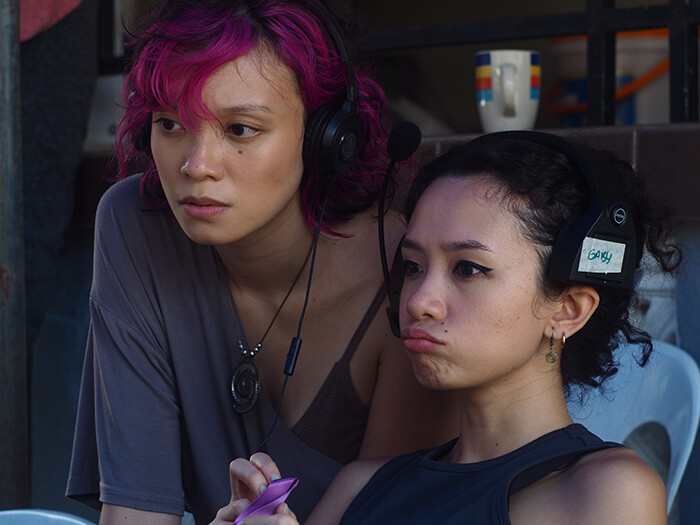
In fact, their respective romantic partners flew in from overseas to join their local crew: Gabriela’s boyfriend Bryn Chainey, director of Rabbit Trap, another QCinema 2025 entry, worked on the score, while Mariana’s partner Ryan Sio, a chef who has a background in audio engineering, served as sound recordist.
Surface Tension is already the fourth material the Serrano sisters submitted to QCinema. In the years that their scripts got turned down, Gabriela crewed for her filmmaker friends participating in the festival, while pitching their other ideas elsewhere. As they make their QCinema debut, it’s hard and perhaps unfair to solely attribute to serendipity what the feminist duo has achieved since Dikit.
Gabriela asks her sister what it’s like to bare her soul behind and in front of the camera yet again. “I’m feeling tension,” Mariana says. “But I’m working towards calling it excitement.”
* * *
QCinema International Film Festival is from Nov. 14-23, 2025. For more information, visit qcinema.ph.