Why a new RJ Guitar is catching fire worldwide
Ramon “RJ” Jacinto and his son RJJ are sitting in his office at the Venture 1 Building in Makati when the son tells the story.
“My dad rarely picked me up from school. But one time he did, he had a talk in our high school, and our last class was P.E. He happened to be watching while I was playing a halfcourt pickup game with my classmates. And I broke the index finger on my left hand. He saw it, and in my head, I was like, ‘Oh, it’s no big deal, I’m right-handed.’ He’s like, ‘What, are you crazy? Let’s go to the hospital, now!’ I said, why? ‘That’s your left hand. You’ll never play guitar again!’”
Talk about guitar obsession.
Seeing RJ and son together is not exactly like seeing double. For one thing, the son is about 6’2”—basketball height, a sight taller than his dad, even if you factor in RJ’s trademark pompadour. Their musical tastes differ as well, the father leaning towards Chet Atkins and The Ventures, while the son is more into Wolfgang Van Halen and John Mayer. They both seem to admire Eric Clapton, the perennial oak of British blues.
One other taste they share: a love of guitars. That trait has trickled down through the genetic line.
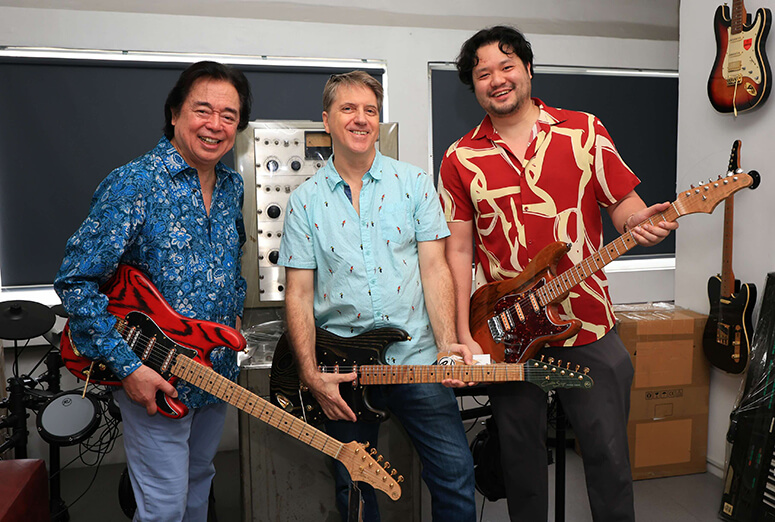
Tradition. It’s what ensures quality is passed from generation to generation. One of the best tributes to local craftsmanship, speaking of guitars, comes from Yatsuzuka Kei of Deviser Guitars Company Ltd., the Japanese custom makers of STR, Momose, Bacchus and Seventyseven electrics. When they decided 12 years ago to start building their custom guitars outside Japan, they picked the Philippines—specifically, RJ Guitars’ factory in Cavite (now in Quezon City)—because, Mr. Kei said, “Music is in your blood.”
Kei sent his own Japanese luthiers to train the Filipinos. “It’s not like making furniture, guitars have a soul,” he mused, even saying “some of the work of luthiers trained in the Philippines could rival the best luthiers in Japan.”
Came the pandemic, Mr. Kei got sick and production halted in the Philippines. Deviser ended its guitar run with RJ Guitars. But he left behind the expertise—along with all the wood, parts and components, which RJ Guitars bought up. Kei is nothing but proud of the work done by Filipino luthiers: “We at Deviser still think of RJ Guitars as family.”
You can almost see Mr. Kei and RJ face-to-face in ceremonial position, the master handing over the gleaming axe to his eager mentee.
So, while no longer making Deviser/Aska guitars for the finicky Japanese market, RJ Guitars has turned those skills into creating a Custom Shop line of hand-crafted models.
In truth, RJ Guitars has been seeking a “holy grail” of Filipino craftsmanship, versatility, playability and affordable price since starting his first factory in 1988. The breakthrough probably came with the Supervintage line in 2016: five guitars in one, from Telecaster to ES335 to Strat to Jazzmaster to Les Paul. That model had quick, lively pickups and enough switches to serve up a buffet of tones.
Those same pickups warm up the new RJ Custom Shop Skycaster. This line of guitars features a Philippine mango/swamp ash body; a flame maple neck with custom V-to-C neck shape that makes it easy for thumbs to slip around at the low end and dance all over the frets at the high end; Gotoh/Wilkinson locking tuners and tremolo system; in-house Supervintage humbucker coils in the bridge, and two RJ alpha coil single coils in the neck and middle positions.

The pickups are hand-wound by RJ’s Japan-trained luthiers, using US magnets and wires, and the controls feature three push-pull knobs for the pickups, with lots of combinations (it comes with an 11-variation cheat sheet).
The new Skycasters have been garnering rave reviews online, from American session players like RJ Ronquillo, to YouTube reviewers like Glenn Fricker (SpectreSoundStudios), Australian Shane (intheblues), Tyler Larson (musiciswin), Danilo Vicari, Sean Daniel, Alan Iarussi, Mike Cole and others. It’s important to realize how key the online world is to amplifying authentic guitar buzz: these people are musicians and guitar techs with thousands and thousands of viewers. They put the RJ guitars through the paces, and kids click madly on these videos. That’s widespread advertising, baby!
But remember: these are not paid endorsers. RJJ researches online, then sends out the Skycasters to people who will really appreciate their craft and feel, especially for the price, and they’ve been giving enthusiastic feedback. “There’s a real push and pull today between players who favor the traditional feel of classic guitars and those who seek modern refinements,” says RJJ. But, he adds, “any modern feature considered for the Skycaster first had to meet RJ’s own playing needs. Nothing was added just to follow trends. Each modern refinement has to enhance playability while preserving the familiar feel traditional players expect.”
With its Strat-type body, the Skycaster appeals to those seeking something comparable to the American gold standard—but many of these reviewers rate the Skycaster even higher! For one thing, the Skycaster has such concentrated pickup and delivery, it plays louder onstage. And all the little options—like the pull-pots, allowing further refinement of sound, the custom slim-to-fat neck, the inverted jack—make RJ’s latest not just an eye-catching novelty, but a sturdy, playable alternative.

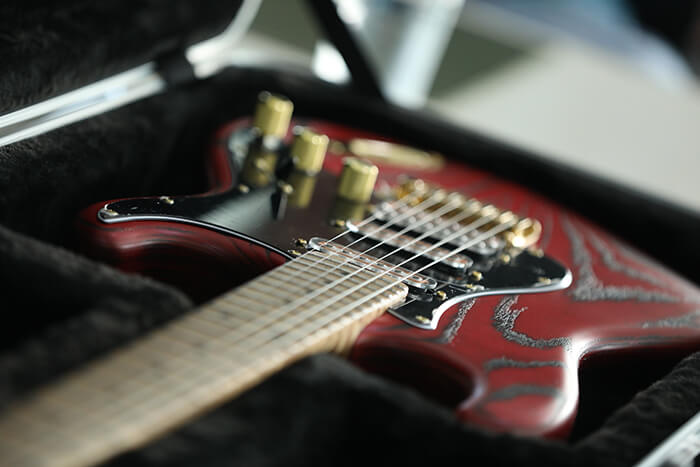
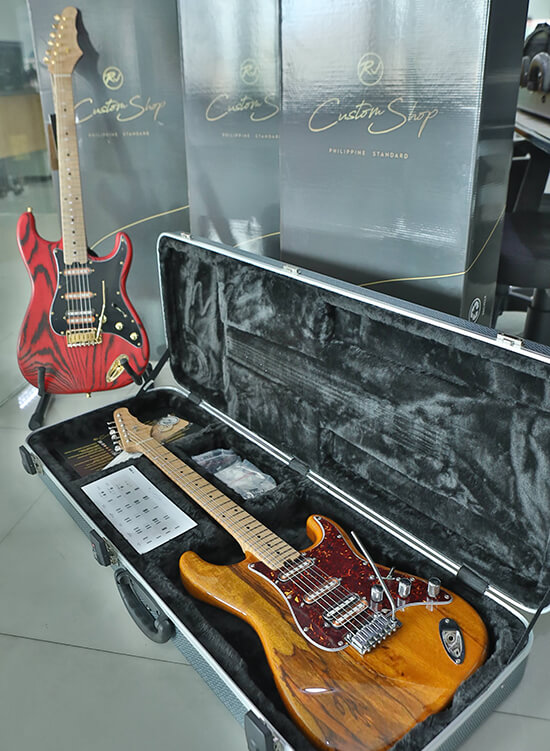
That’s not even mentioning the price (starting at $1,099), a fraction of similar US- and Japan-made custom guitars. Funnily, affordability never even comes up among these reviewers: instead, they’re lured by the interesting features and wood details. We picked up three models—the Scarlet Aburi Ash, Philippine Natural Mango, and Black Kintsugi Ash—from the solid TSA-ready cases to try them out.
In RJ’s corporate meeting room, where the surrounding glass windows are filled with scrawled design ideas, sales formulae and business stats in erasable Sharpie like something from A Beautiful Mind, the “Guitar Man” sits and demonstrates the versatility of the Skycaster, noting their direct-to-customer Custom Shop can ship guitars around the world for a flat $99, but they’re already six months behind in filling online orders. Apparently, word is spreading. In the meantime, the Shop is delivering the latest Supervintage models to meet local demand.
RJJ is handling this new boom in online interest, even though he’s sometimes a reluctant guitarist himself. “It’s always like jumping in the pool,” he says of performing onstage with his dad. “Sometimes, they have a big concert, and they rehearse maybe twice—big rehearsals. And sometimes they tell me after the rehearsal, so I don’t even get to do that!”
“But he’s a very good musician,” notes RJ, “and his sense of timing is better than mine, even his rhythm. He’s a natural. But he doesn’t believe me! He’d rather play basketball.”
“Put it this way,” says RJJ. “I’m glad I never say no when he asks me to play. Because that’s what’s important, after: you still have that memory, the experience, which is great.”
RJ himself doesn’t seem too shocked that people from the US, Australia, and Europe are now raving about these guitars.
“When I talk to the influencers, they’re like, ‘Why is it so good?’ I said, you know, after all the bells and whistles, it’s really the playability and pickups.”
Yup. It always comes down to the basics. And those are the things that need to be taught and handed down.
* * *
To order or learn more, go to https://www.rjguitars.store/guitars/custom-shop.