Certainly not doggerel
The way generational relationships have been evolving, we might apply an oxymoron and say it’s been gently raining cats and dogs on domestic intimacy. From the roofs of our homes to bedrooms and basements, we can also expect more of their inclusion as familiar subjects for creative expression. The past decades have just purred with precedents, such as Andrew Lloyd Webber’s musical Cats that was based on a 1939 poetry collection by T.S. Eliot.
For canine conspiracy, Rin Tin Tin of 1923 is still acknowledged as among the best movie dogs of all time, antedating Lassie in 1943. The most famous fictional dog remains Snoopy of Schulz’s “Peanuts” comic strip—a paw or two above Scooby-Doo and Pluto. Netflix now lists double-digits of dog movies. The most recent include the docuseries Inside the Mind of a Dog, the true-story film Rescued by Ruby, and the drama Dog Gone.
Dog poetry recalls Rudyard Kipling’s “The Power of the Dog,” Pablo Neruda’s “A Dog Has Died,” Elizabeth Barrett Browning’s “To Flush, My Dog,” and more recently, contemporary poet laureate Billy Collins’ “Dharma.” Poetry Foundation has a curated collection of poems about dogs by assorted authors, with most commonly expressing touching tributes or poignant reflections.
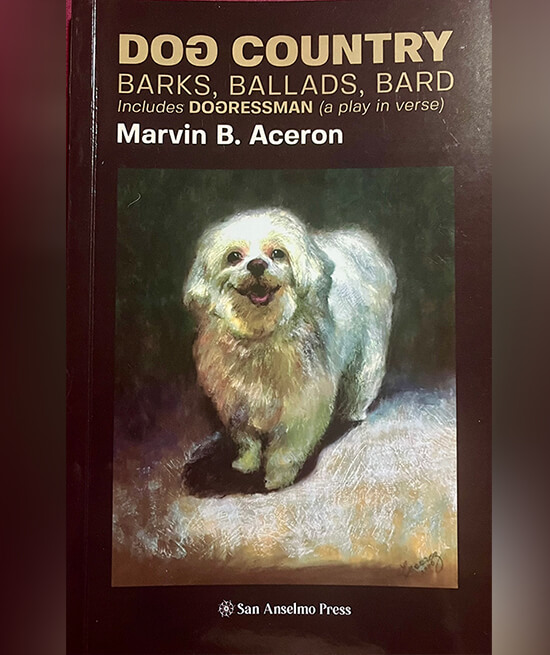
Recently launched locally was a slim but entirely entertaining book that offers poetry of levity, satire, parody, and warm engagement. Celebrating “doghood”—the realm of man’s best friend—is Dog Country: Barks, Ballads, Bard—Includes Dogressman (a play in verse) by Marvin B. Aceron, published by San Anselmo Publishing, Inc. It has 25 poems and “A One-Act Verse Play in the Parliament of Animals).”

The lead-off poem is titled “First World Dogs (Para sa Mga Aso ng Ayala).” Excerpts: “No askals’ litter here./ Every dog is vaxxed./ And oh, they don’t look at you/ like you’d run off with their owner’s car.// They glance away, polite, indifferent,/ bounce to their rhythm,/ proudly declare:/ we’re first world dogs/ we can’t go out without our yayas/ in this third world country.// And if they chance upon the neighbor’s dogs,/ they bark at each other as if to greet/ and let their yayas pull them away.”
Editor Alma Anonas-Carpio notes: “(Aceron) writes truths in a manner that crosses the gradients of funny, somber, introspective, observational, contemplative, and lighthearted. His pen, even in its lightest moments, balances cutting wit with the gravitas of honesty and sincerity.”
“Palomo” has the following lines: “My grandpa wept as he held Palomo,/ who took his last breath shortly. I touched his/ soft fur to say goodbye. Wet eyes staring/ on blank space. Ah, this happened 40 years/ ago. I sob like t’was this afternoon.”
Personification comes into play in “Dog Tango”: “Human/ you ask why I bark/ when the neighbor’s dog barks?// We don’t know each other./ We’ve never met./ But a bark is a bark,/ and it stands to our doghood/ to answer.// One barks—/ the rest follow./ That’s how we bond.// That’s doghood, man,/ our space, our time.// You sing./ We bark./ That’s the tango./ You tell us to shut up./ I walk away/ and bark back,/ ‘Dogs only.’”
In the poem titled “Marcos and Cory,” they’re “dogs/ born around the time of the/ Snap Elections of 1986.// Brown-haired askals,/ free to roam the streets all day,/ until A., in his alpha male voice,/ called them home.//” They undergo different fates, since A.’s family are Ilocanos. Until “And in the yard,/ Bong Bong,/ sired by Marcos,/ was tied up from the start.// By his side,/ a puppy—wobbly on his feet,/ too young to understand his name.”
Other poems are titled “Dog Language,” “Poopito Ergo Sum,” “Now, Barabbas Had a Dog,” “First Dog in Hell,” and “Bark Poem.” The final one is titled “Robredog.”
An epigram quotes Leni recounting how “I was putting Rocco to sleep while we were attending a Zoom Mass officiated by Cardinal Tagle…” She apologizes for failing to let go of her dog when her frame was spotlighted “because the good Cardinal wanted to pray over me.”
The poem proper takes the voice of Rocco who says there was no need for an apology. “But happy dogs are all alike./ Some are happier still/ when a Cardinal prays over/ while they sleep.// And some, happiest of all,/ wake to find themselves trending—/ their master caught in an// unscripted moment,/ praying as she always does,/ eyes closed,/ gently embracing/ her dog as it sleeps.// You can’t fake that kind of life. / No apology required.”
Certainly not doggerel.
The book is available through San Anselmo Publications, Inc.’s Facebook page, and will also be sold and signed at Booth 2-156 of the SMX Convention Center in SM Mall of Asia during the Manila International Book Fair (MIBF) 2025 on Sept. 10-14.